
While equity managers commonly use commissions to pay for research, fixed income managers continue to write checks from their P&L for third party research, such as Bloomberg. Why? Has it always been this way? Is there a better way?
Looking back at the 1980’s and 90’s, it was common for fixed income managers to designate a portion of the selling concession to brokers that provided research, including third party research. Designating 10-20% of the selling concession was standard practice. This practice was supported by FINRA Rule 5141, formerly NASD Rule 2740, and it could be argued that these designations were, in large part, instrumental to the funding of independent research services, including Bloomberg. Initially, CAPIS and Autranet, a division of DLJ, were chosen to “provide” Bloomberg because both firms had the capability to generate research credit on fixed income trades, both new issues and secondary transactions.
Fixed income managers were so successful in generating research credit with new issues that the use of secondary transactions for research became unnecessary. Why put a commission on secondary transactions when you have enough new issue activity to cover your independent research costs?
Fast forward to the early 2000’s. Lead underwriting managers began structuring syndicates with predefined economics, essentially eliminating the ability for a fixed income manager to designate brokers for third party research. At first, the smaller fixed income shops were cut off, and by 2008, the ability to designate a portion of the selling concession for third party research was all but gone. This was not a change in the regulatory framework. It was an economic decision by the lead underwriters. In the years that followed, fixed income managers accepted their fate and either began paying for third-party research services in cash or asking the equity team to carry the burden.
EQUITY COMPARISON
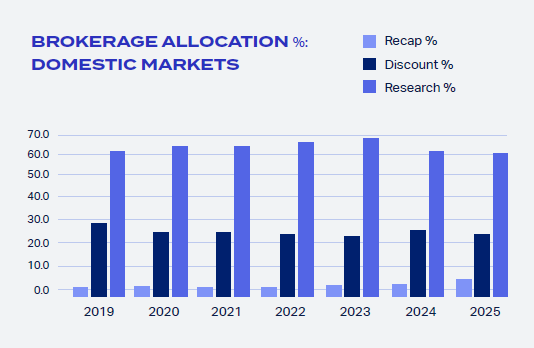
Consider the fact that most equity managers use a “execution-plus” model to offset the cost of research services. This has been accepted practice for the past 50 years and is part of the economic structure that underpins the active management eco-system. Without the use of commissions for research, many small and mid-sized managers would not be able to compete with their trillion-dollar competitors.
Based on the CAPIS Universe*, we can see that research commissions have been between 60% and 70% of all commissions paid for at least the past 8 years. This includes both bundled and third-party research commissions.
COST OF RESEARCH: ~2 BPS
Making some basic assumptions regarding execution rates, research rates, and turnover, we can estimate that the cost of research for the average active equity manager is approximately 2 basis points. For fixed income managers, the question is whether adding a few basis points for research is reasonable.
RETURNING TO FIXED INCOME
Over the years, very little has changed on the regulatory front. Section 28(e) continues to provide a safe harbor for managers that elect to use client commissions for research and FINRA Rule 5141 continues to support the provision of research in conjunction with fixed price offerings.
Bottom line, fixed income managers have a decision to make. Should they continue to pay for research out of P&L, or do they want to take advantage of the regulatory framework that is available to offset the cost of research. Status quo is easy. Making a change takes work. Is it worth it?