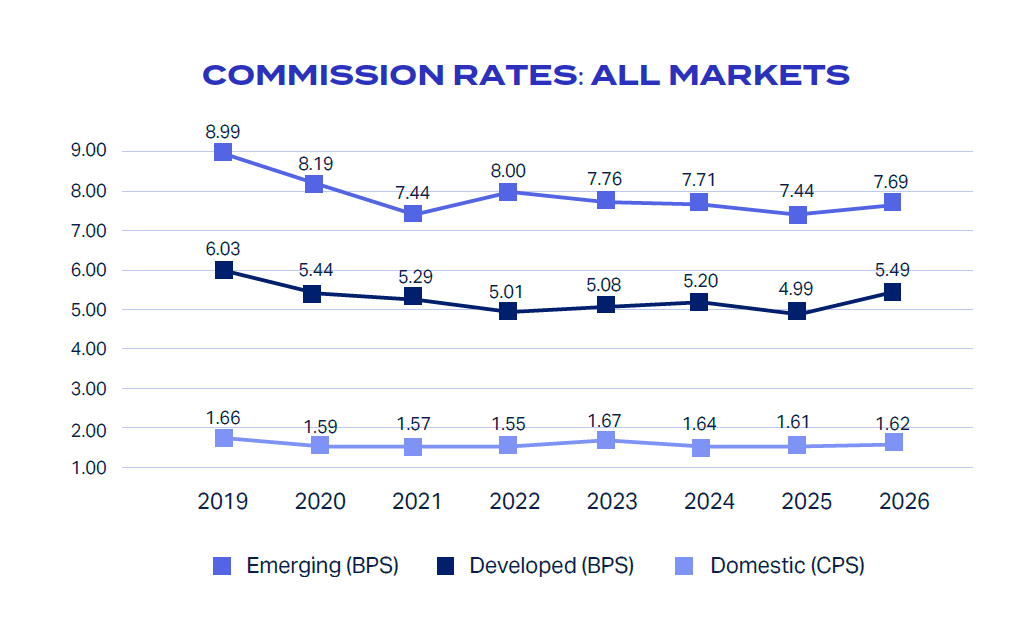
The initial impact of MiFID II on commission rates and research commission usage appears to have subsided. Rather than showing a continuing decline, the data now points to stabilization in commission rates and a renewed use of commissions for research in developed and emerging markets. The domestic market remains structurally different: U.S. commission rates have clearly stabilized, and research continues to be an important component of the institutional trading landscape.
Developed Markets (Ex-US)
In developed markets, the data suggests that the initial MiFID II disruption has largely run its course. Commission rates have generally leveled off, and research commissions as a percentage of total commissions no longer support a simple downward-trend narrative. After declining from the 2019 level and reaching a low point around 2022, research commission usage has moved back above 50%, indicating a meaningful rebound in the use of commissions for research.
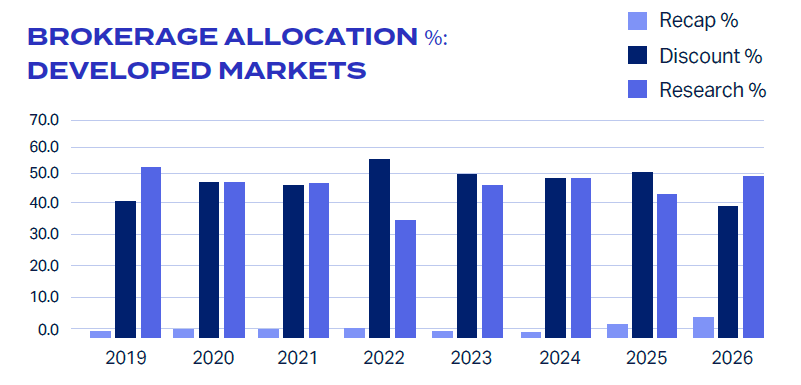
Commission rates have continued to hover around 5
basis points (bps), moving from 6.03 bps in 2019 to 4.99 bps in 2025. The 2026 partial-year sample has raised the rate to 5.49 bps, but that increase should be treated as directional until a full-year sample is available. The broader conclusion is that developed-market rates have stabilized, while research commission usage has recovered from its post-MiFID low.
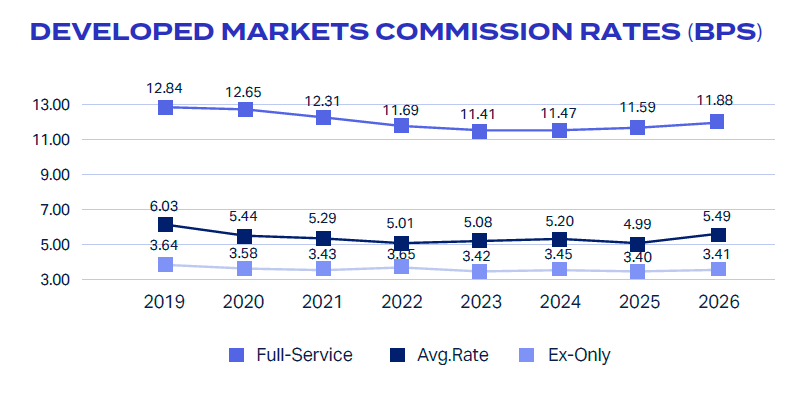
Execution-Only Rates versus Full-Service Rates
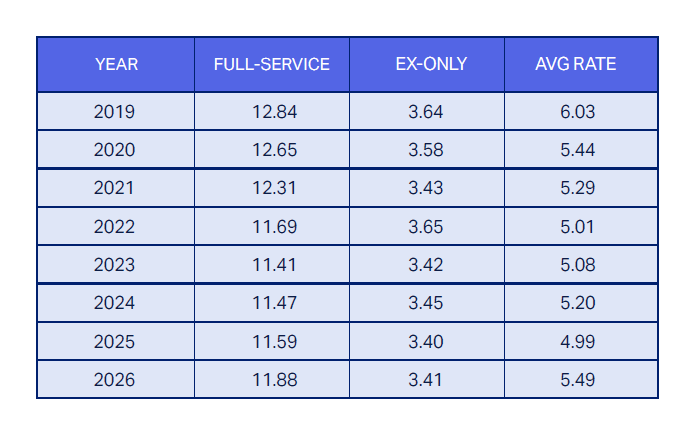
Separating commissions into execution-only and full-service categories helps explain the bifurcation of rates. The average full-service, or research commission, rate remains approximately 12 bps, while the execution-only rate has settled around 3.5 bps. This spread indicates that CSA credits remain meaningful and that larger advisors may continue to negotiate more aggressive commission rates and research allocations.
Emerging markets show a similar pattern. The early post-MiFID period was marked by a sharp decline in commission rates and research commission usage, but the more recent data points toward normalization rather than continued erosion. Rates have moved within a narrower range, and research commission usage appears to be increasing from its prior lows.
Emerging Markets
The current data suggests that emerging-market research commissions remain relevant despite the higher execution costs and market-by-market variation. Commission recapture remains minimal in emerging markets, but the broader trend points to a renewed willingness to use commission dollars for research where market structure and client mandates allow.
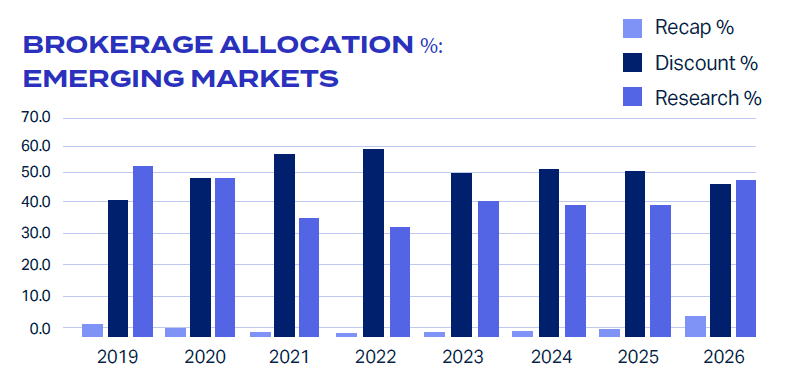
After the initial decline, commission rates generally moved in a narrower range, with the average rate at 7.44 bps in 2025 after 7.71 bps in 2024. It remains worth noting that KRW and TWD drive these blended rates lower, while other markets remain above 15 bps. As a result, the aggregate average may understate the cost of trading in many individual emerging markets.
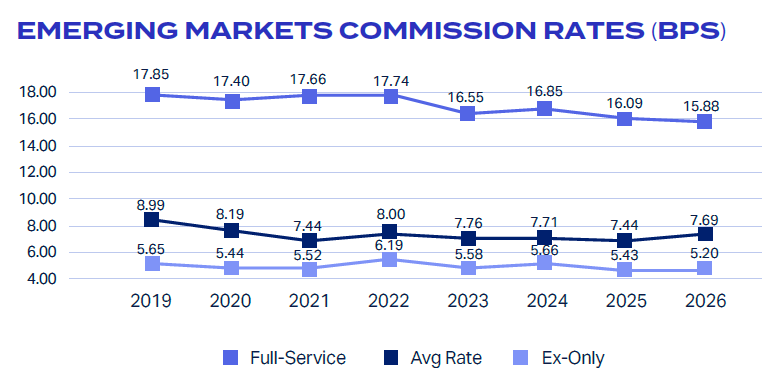
Ex-Only Rates versus Full-Service Rates
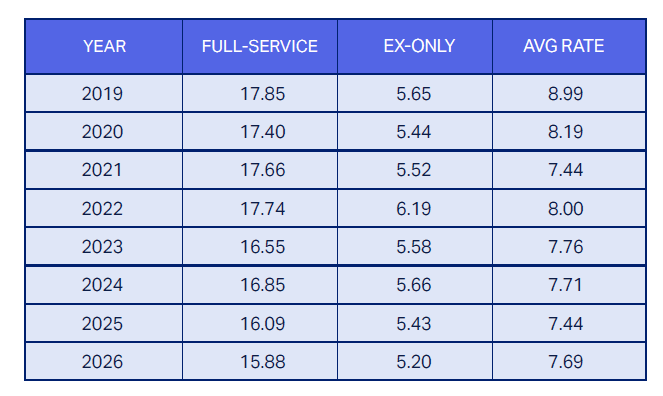
Separating commissions into execution-only and full-service categories helps explain the bifurcation of rates. The average full-service, or research commission, rate remains around 17 bps, while the execution-only rate has settled in the mid-5 bps range. This spread provides a useful estimate of the CSA credit that may be available, with larger advisors generally able to negotiate more aggressive commission rates and research allocations.
The domestic market remains structurally different from developed and emerging markets. U.S. commission rates have clearly stabilized, and research continues to be an important component of the institutional trading landscape. While soft dollar usage may fluctuate year to year, the U.S. market continues to rely on commissions as a meaningful mechanism for supporting research and advisory economics.
Domestic Markets
Commission recapture also remains viable in the U.S. market. As a discounting mechanism for full-service rates, commission recapture reduced net commissions in 2025 from 1.61 cps to 1.52 cps and generally acts as a direct reduction of soft dollar, or research, allocations.
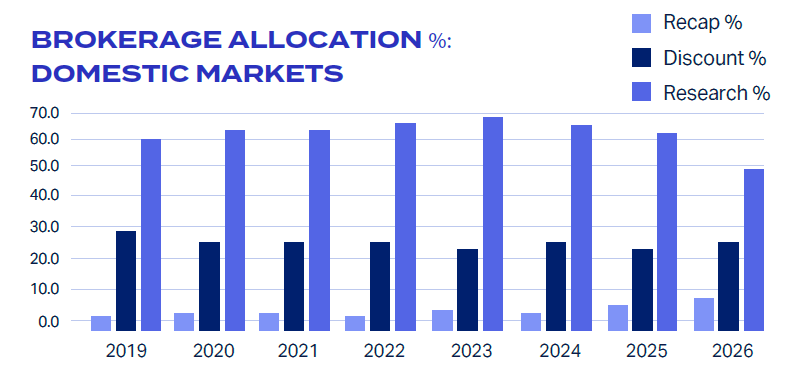
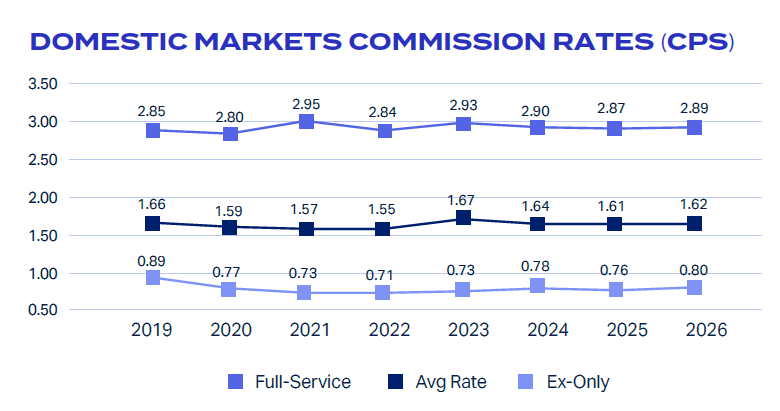
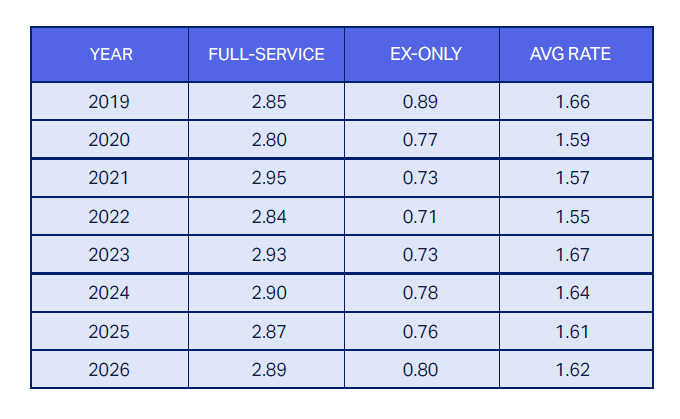
Domestic commission rates have shown only modest movement, shifting from 1.66 cps in 2019 to 1.61 cps in 2025. Compared with the more pronounced changes in foreign markets earlier in the period, the U.S. market now appears comparatively stable.
Ex-Only Rates versus Full-Service Rates
Separating commissions into execution-only and full-service categories helps explain the bifurcation of U.S. rates. The average full-service, or research commission, rate is slightly below 2.9 cps, while the average execution-only rate is roughly 77 mils. This spread provides a useful estimate of the CSA credit that may be available, with larger advisors generally able to negotiate more aggressive commission rates and research allocations.
Key Takeaways
Research commission usage in developed and emerging markets appears to be increasing from prior lows, pointing to renewed use of commissions for research.
The U.S. market remains structurally different, with stable commission rates and research continuing to play an important role in institutional trading economics.
Developed and emerging market commission rates have generally stabilized rather than continuing to decline.
The initial MiFID II impact appears to have subsided in foreign markets.
For comparison, the chart displays domestic commission rates in cents per share (cps) and developed and emerging market rates in basis points (bps). This format highlights the structural difference between domestic and foreign commission levels while preserving the market-specific units used throughout the report. In 2022, the expectation was that developed and emerging market commission rates would continue to decline. With data now extending through 2025 and Q1-Q2 2026 included, that thesis appears too narrow.
The better conclusion is that the initial MiFID II effects have subsided: foreign market commission rates have stabilized, and research commission usage in developed and emerging markets is showing signs of renewed strength. In the domestic market, commission rates remain comparatively steady, and research continues to be an important component of the institutional landscape. The 2026 figures are useful directional inputs, but they should not be weighed too heavily until a full year sample is available.